

Why a College Degree No Longer Guarantees a Job in India
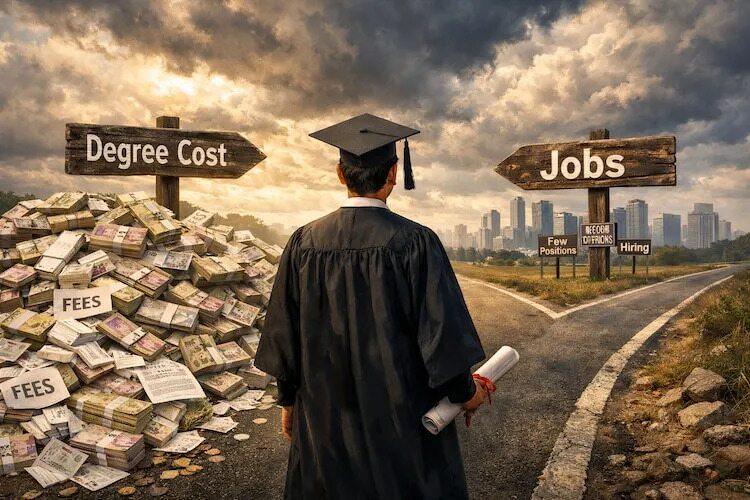
For decades, the standard formula for societal mobility in India was simple and predictable: work hard in school, clear competitive entrance exams, graduate from a registered college, and walk straight into a secured corporate job. Generations of families have operating under this exact blueprint, believing that a formal degree is the ultimate insurance policy against economic instability.
However, in the current economic landscape, that formula has fundamentally broken down. Today, having a fresh university degree in hand is no longer a guarantee of employment; in fact, it is increasingly becoming a symbol of an alarming structural gap.
India finds itself in a strange paradox where corporate job openings remain unfilled for months due to a "talent shortage," while millions of educated youths remain unemployed. The issue isn't that India lacks degrees-it's that the current credentialing ecosystem is heavily decoupled from actual execution capability.
The Illusion of Academic Qualifications
The current disconnect between higher education and market demand has moved from an internal HR issue to a massive macroeconomic challenge. According to recent demographic assessments, nearly 40 percent of young graduates under the age of 25 face structural unemployment, a reality highlighted intensely by this report on the broken system.
This friction persists because the explosive expansion of higher education institutes across tier-2 and tier-3 cities has severely diluted instructional quality. The market is facing two distinct crises simultaneously:
-
The Skill-Curriculum Deficit: Traditional university syllabi often remain static for years, teaching legacy programming languages or outdated management models while the global market moves rapidly toward advanced automation, generative AI, and real-time cloud architectures.
-
The Institutional Trust Deficit: The market is crowded with unaccredited entities and paper mills that trade degrees for tuition fees without providing physical lab access, practical capstone projects, or industry exposure.
As a result, a degree has transformed from a proof of competence into a mere document of attendance. Corporate recruiters can no longer trust an institutional stamp blindly, creating immense frictional drag in candidate sourcing.
The Failure of Post-Facto Validation
When enterprise teams realize they cannot trust academic credentials at face value, they build heavy, multi-layered defensive screening mechanisms. Traditional background verification (BGV) processes operate completely post-facto-meaning they happen after a candidate has progressed through interviews and received a conditional offer letter.
This retrospective checking model creates a severe operational bottleneck. BGV agencies spend weeks trying to connect with unorganized university administrative offices to confirm if a specific serial number matches a real graduate roll.
If the candidate's degree turns out to be fraudulent or issued by a blacklisted institution, the company has to scrap the entire selection cycle, losing months of project velocity and resource allocation. The modern corporate environment requires a framework that validates trust before the interview loop even begins.
Building an Immutable Proof-of-Capability Layer
Fixing this structural disconnect requires transitioning the entire workforce market from unverified, self-reported text resumes to an ecosystem of immutable, source-verified digital identities. This structural transition is precisely what Skill Passport is executing across the recruitment sector.
Engineered on a foundation of permissioned distributed ledger technology (Blockchain) combined with automated evaluation models, the platform acts as a secure, decentralized registry for professional and academic records.
Instead of generating paper degrees that are highly vulnerable to forgery, verified educational institutes, technical bootcamps, and enterprise employers commit milestones directly to the ledger as block entries. Once signed and sealed cryptographically, these milestones are permanently unalterable. No external entity can simulate, alter, or falsify an academic or professional record once it lives on-chain.
Moving from Static Documents to Verifiable Truth
Mrityunjaya Prajapati, the Founder and Architect of Skill Passport, explains how redefining credential data integrity directly transforms graduate employability:
"The reality is that India does not have a shortage of raw intellectual potential; we have a systemic failure in how that potential is verified and displayed. A traditional college degree tells us what a student memorized for an exam, but it doesn't prove their current operational readiness to an enterprise. By moving professional identities onto a decentralized, secure ledger, we eliminate the trust deficit completely. We give authentic talent a platform where their real skills are cryptographically verifiable in real time, making background fraud obsolete."
Through this decentralized framework, the platform re-engineers talent pipelines via clear structural changes:
-
Instant Cryptographic Verification: Recruiters instantly check a candidate’s academic integrity via public-key cryptography, bypassing the traditional 30-day manual background verification wait time entirely.
-
AI-Powered Capability Tracking: Integrated AI modules dynamically evaluate candidate achievements alongside institutional authority ratings to output an unalterable "Skill Strength Score," highlighting project readiness immediately.
-
Absolute Candidate Data Ownership: Built in complete structural alignment with India's Digital Personal Data Protection (DPDP) Act, individual professionals retain full custody of their data vaults, opening temporary access to enterprises via strict consent-driven protocols.
The Road Ahead for Indian Talent
As global industries look to deploy highly secure, agile, and instantly ready workforces, relying on unverified paper resumes is a significant business risk. Solving India's graduate readiness challenge requires more than just launching additional training programs; it demands a radical overhaul of our digital trust architecture.
Under the technological roadmap championed by innovators like Mrityunjaya Prajapati, platforms like Skill Passport are successfully turning this vision into reality. By anchoring real human capabilities onto an unalterable, secure data infrastructure, the hiring market can eliminate costly administrative delays, bypass unaccredited paper institutions, and connect genuine, verified skill sets directly with the global enterprise ecosystem.
 Portuguese (Brazil)
 English
 Arabic
 French
 Spanish
 Portuguese
 Deutsch
 Turkish
 Dutch
Dutch
 Italiano
 Russian
 Romaian
 Greek
Greek