

SaaS Adoption in Insurance: How Cloud Technology Can Accelerate Insurance Product Innovation
Insurance products are rarely static. Customer expectations change, new risks emerge, competitors introduce new offerings, and regulators continue to evolve the rules surrounding insurance markets. For carriers, responding to these changes quickly can be difficult when product development depends on rigid technology environments.
This is one reason SaaS adoption in insurance is becoming an important part of the product innovation conversation.
Software as a Service is not simply about accessing software through the cloud. For insurers, modern SaaS can provide configurable workflows, integrations, automation, analytics, and continuously updated capabilities that can help organizations adapt their technology environment as business requirements change.
The National Association of Insurance Commissioners (NAIC) identifies technology innovation as a force affecting insurance product development, risk assessment, distribution, claims, and customer interactions.
Product Innovation Is Also a Technology Challenge
An insurance organization may have a strong idea for a new product but still face a practical problem: how quickly can the technology support it?
Launching a product can involve product configuration, underwriting rules, pricing, forms, billing, policy administration, distribution, reporting, and customer-service workflows.
If these functions depend on heavily customized legacy systems, a relatively straightforward business initiative can become a lengthy technology project.
That can create a gap between business innovation and technology readiness.
SaaS can help reduce this gap by providing more configurable technology components.
From Custom Development to Configuration
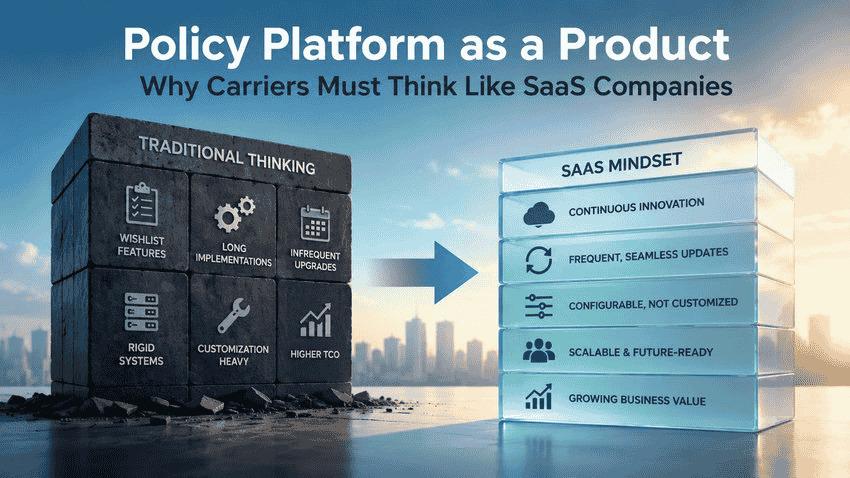
Traditional insurance technology frequently depends on custom development.
Every change may require developers to modify code, test the system, coordinate releases, and manage dependencies.
Modern SaaS platforms can shift some of this work toward configuration.
Instead of building every business change from scratch, insurers may be able to configure workflows, rules, integrations, and product capabilities using tools provided by the platform.
This does not eliminate development.
Rather, it can reduce the amount of custom development required for routine changes.
That distinction can have a major effect on speed.
APIs Create More Possibilities
Product innovation increasingly depends on external data and technology services.
An insurer may want to integrate property data, geographic information, payment services, fraud analytics, customer communication tools, or specialized risk models.
APIs can provide the connection between these capabilities.
A SaaS platform with strong integration capabilities can allow insurers to add specialized services without redesigning the entire technology environment.
This creates a more modular approach to innovation.
Instead of one system doing everything, different components can contribute specific capabilities.
SaaS Can Help Test New Ideas
Innovation does not always begin with a large product launch.
Insurers may first want to test an idea with a particular customer segment, geography, distribution channel, or risk category.
A flexible SaaS environment can support smaller experiments.
The insurer can introduce a capability, measure its performance, collect feedback, and then decide whether to expand it.
This creates a more iterative approach to product development.
The organization learns from real-world results rather than relying entirely on assumptions made before implementation.
AI Is Changing Product Design
Artificial intelligence adds another dimension to insurance innovation.
The NAIC reports that insurers are using or exploring AI/ML across areas including underwriting, pricing, claims, fraud detection, and customer service.
This creates opportunities for new products and new ways of servicing existing products.
For example, AI-enabled tools can support risk analysis, document processing, customer interactions, and claims workflows.
But AI also requires appropriate governance.
The NAIC's guidance emphasizes that insurers remain responsible for complying with applicable laws and regulations when using AI systems.
Therefore, AI-enabled SaaS should be evaluated not only for functionality but also for transparency, security, monitoring, and human oversight.
A New Insight: The Faster Product Cycle Can Improve Learning
Speed to market is often presented as the primary benefit of modern insurance technology.
There is another advantage: speed to learning.
Suppose an insurer launches a new product.
The technology can help collect information about quotes, customer behavior, underwriting outcomes, claims, and service interactions.
If these data points are connected, the insurer can learn what is working and what needs adjustment.
This creates a continuous cycle:
Launch → Measure → Learn → Improve → Relaunch
SaaS can support this cycle by making technology changes and integrations more manageable.
Why Legacy Systems Still Matter
SaaS does not mean insurers must immediately abandon legacy platforms.
In reality, many carriers will continue operating legacy systems for years.
The practical strategy may be to connect modern SaaS capabilities with existing core systems while gradually reducing dependence on rigid technology components.
This approach can lower disruption and allow the insurer to prioritize modernization where it delivers the most business value.
What Insurers Should Consider Before Adopting SaaS
A product-focused SaaS strategy should evaluate:
- Configuration flexibility
- API and integration capabilities
- Product-rule management
- Data accessibility
- Security controls
- Regulatory support
- AI governance
- Scalability
- Vendor stability
- Data portability
The cheapest platform is not necessarily the best option.
A platform that is inexpensive to implement but expensive to modify may ultimately create the same technology constraints the insurer was trying to eliminate.
The Future of Insurance Product Innovation
The insurance companies best positioned to innovate may not necessarily be those with the largest development teams.
They may be the organizations with technology that makes experimentation easier.
That is where SaaS adoption in insurance can become strategically important.
A flexible SaaS environment can help insurers introduce new capabilities, connect external services, test ideas, and continuously improve products.
The ultimate goal is not simply faster software deployment.
It is creating an organization where business innovation and technology innovation can move together.
For American insurers, that ability can become increasingly important as customer expectations, emerging risks, AI capabilities, and competitive pressures continue to evolve.
 Portuguese (Brazil)
 English
 Arabic
 French
 Spanish
 Portuguese
 Deutsch
 Turkish
 Dutch
Dutch
 Italiano
 Russian
 Romaian
 Greek
Greek