

SOC Managed Services: Costly Security Gaps Indian BFSI Firms Can Avoid
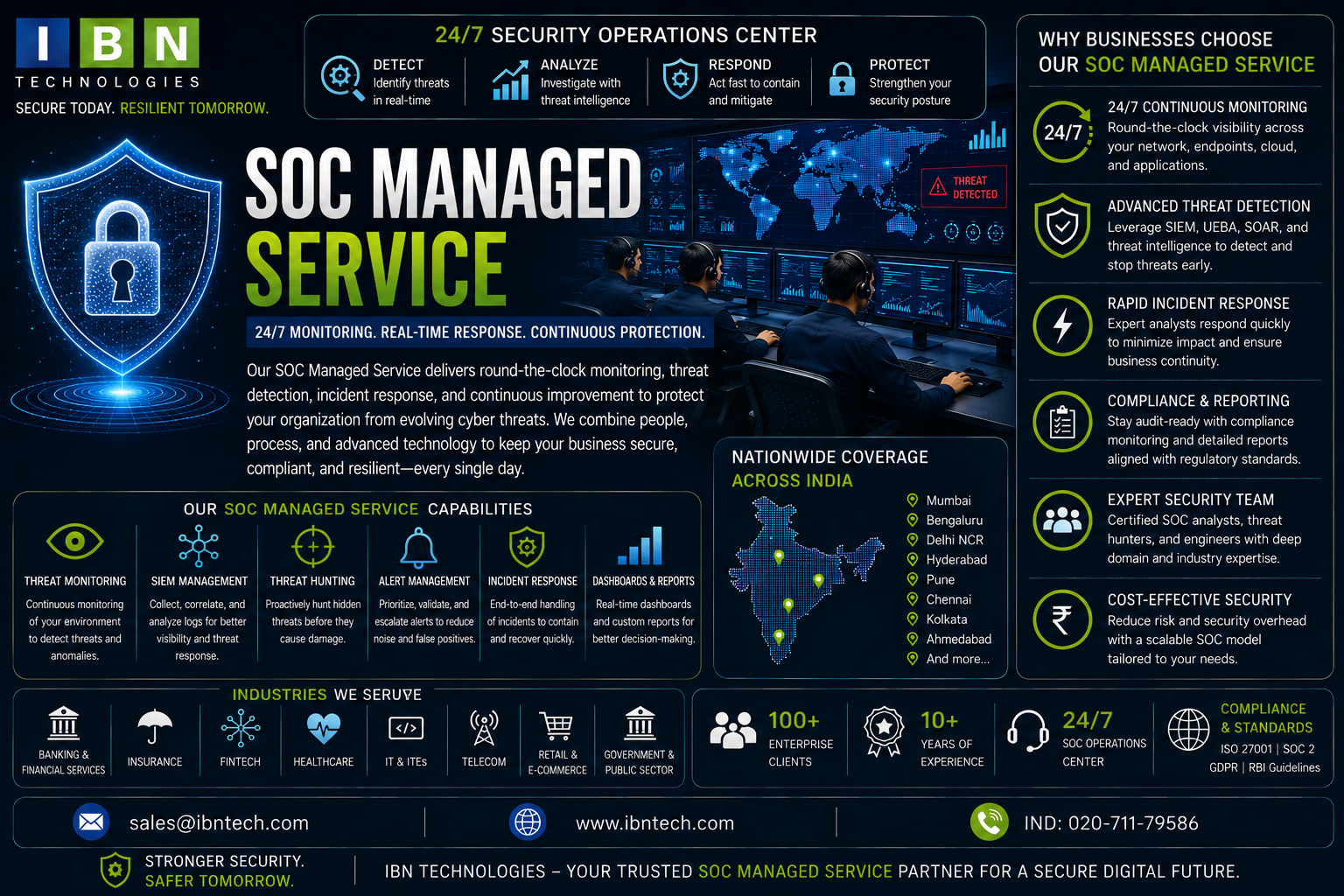
Before You Buy soc managed services, Ask What Your BFSI Operation Really Needs
Security spending in BFSI cannot be evaluated like an ordinary technology purchase. Financial organizations operate technology environments where applications, user identities, infrastructure, endpoints, and other systems can carry significant business importance. As these environments become more complex, maintaining effective security monitoring can require substantial operational capacity.
That is why soc managed services are increasingly relevant when BFSI leaders evaluate how to strengthen security operations. The question, however, should not be whether an organization can purchase a managed SOC. It should be whether the service provides the right combination of visibility, investigation, escalation, and operational support for its environment.
What should BFSI firms expect from SOC managed services?
SOC managed services provide ongoing security operations support that can include monitoring, security-event analysis, investigation, escalation, and related reporting or operational processes.
For BFSI organizations, the purpose is to establish a repeatable approach to security events. Instead of depending entirely on individual teams to recognize and investigate suspicious activity, a managed SOC can provide a dedicated security operations layer.
This can complement internal security and technology expertise. The organization's teams remain responsible for business decisions and technical actions within their environments, while the SOC supports the process of identifying and assessing potentially significant security activity.
What Top SOC as a Service Providers Should Be Evaluated On
Searching for top soc as a service providers can produce a long list of potential vendors, but rankings and brand visibility are not enough to make a sound BFSI decision.
Financial organizations should evaluate providers against operational requirements. The important questions concern monitoring coverage, alert analysis, investigation depth, escalation procedures, reporting, responsibilities, and how the service fits the organization's technology environment.
A provider may be technically capable but still unsuitable if its operating model does not align with internal processes.
The better approach is to define the organization's requirements first and then evaluate providers against them.
Why BFSI organizations should look beyond the monthly fee
The apparent cost of a managed SOC is only one part of the business case.
An internal security operation requires people, specialist skills, technology, processes, management attention, training, and sustained operational capacity. A managed service shifts some of those responsibilities into an external operating model, but the organization still needs to understand what work remains internally.
This is why price comparisons can be misleading.
One provider may offer a narrow monitoring service, while another may provide broader operational support. If the lower-cost option requires internal personnel to perform substantial investigation or escalation work, the difference in price may not represent the difference in total operational effort.
BFSI procurement teams should therefore compare complete service scope rather than headline pricing.
The cost drivers behind a managed SOC decision
Several factors can influence the resources required to operate a managed SOC environment.
Monitoring scope
The number and type of technology environments requiring visibility can affect operational complexity. BFSI organizations should identify which systems are critical to security monitoring rather than assuming every asset needs identical treatment.
Security-event volume
Different environments can generate different amounts of security activity. More events may require greater analysis and prioritization capacity.
Investigation depth
There is an important difference between receiving an alert and having security personnel assess what the alert means.
BFSI organizations should understand how suspicious events are investigated and what information is available to internal teams.
Escalation requirements
A serious security event may require action from internal security, infrastructure, application, identity, or management personnel.
The more clearly these responsibilities are defined, the easier it becomes to evaluate the operational value of a managed service.
Reporting expectations
Leadership may require high-level security visibility, while technical teams need detailed information for investigations. Reporting requirements should be discussed as part of the service evaluation rather than treated as an afterthought.
Why the cheapest model may not deliver the lowest total cost
Consider a BFSI organization that selects a low-cost monitoring service but receives large volumes of unprioritized alerts.
Internal security personnel then spend significant time reviewing events and determining which deserve attention. The organization has technically purchased security monitoring, but much of the operational burden remains in-house.
Another organization may choose a broader managed model that provides more investigation and escalation support. The initial commercial cost may be higher, but internal personnel may spend less time handling routine security operations.
Neither approach is automatically better. The important question is where the operational work sits and whether that distribution makes sense for the organization.
A BFSI scenario: evaluating the internal-versus-managed model
Imagine a financial services organization with an established IT team and a smaller security function.
As its technology environment grows, the number of security events requiring attention increases. Security staff must divide their time between monitoring, investigations, governance activities, and other priorities.
Leadership begins considering whether to expand internal security operations or use a managed model.
The right evaluation would examine the organization's current staffing, monitoring requirements, incident processes, technology environment, and internal responsibilities.
A managed SOC may provide additional operational capacity while allowing internal security personnel to focus on areas where their organizational knowledge is most valuable.
The decision is therefore less about replacing employees and more about determining the most sustainable operating structure.
Questions to ask a potential SOC provider
BFSI procurement and security teams can use the following questions when evaluating a service:
- Which systems and environments are covered?
- How are security events prioritized?
- Who investigates potentially significant alerts?
- What information is provided during an investigation?
- How are serious incidents escalated?
- Which response actions remain with the customer?
- What reporting is provided to security leadership?
- How does the service accommodate changes to the technology environment?
- What internal resources are still required?
- How is service performance reviewed over time?
Answers to these questions can reveal more about practical fit than a generic list of security capabilities.
Best practices for managing the relationship
A managed SOC should be treated as an operational relationship rather than a one-time procurement event.
The organization should establish clear ownership, escalation contacts, communication expectations, and reporting requirements. It should also review whether the monitoring scope continues to reflect the current technology environment.
Regular service reviews can help identify recurring alerts, changes in business priorities, and areas where internal or external responsibilities need adjustment.
Internal teams should also understand how to interact with the SOC during an incident. Clear communication can reduce confusion when a security event requires action across multiple technology functions.
BFSI security operations checklist
Before moving ahead with a managed SOC arrangement, leadership should:
- Define the systems that require security monitoring.
- Identify critical security-event categories.
- Document responsibilities between internal teams and the provider.
- Review investigation and escalation processes.
- Establish communication expectations for significant incidents.
- Determine the reporting required by management.
- Assess the internal workload that remains after outsourcing.
- Review how the service will scale with technology changes.
- Identify recurring operational security issues.
- Establish criteria for measuring service effectiveness.
This gives stakeholders a practical framework for evaluating both cost and operational value.
Compliance and accountability still matter
BFSI organizations may have regulatory, contractual, privacy, governance, and information-security obligations that vary according to their specific activities and operating environments.
A managed SOC can support security monitoring and incident-management processes, but it should not be presented as an automatic compliance solution.
The organization remains responsible for understanding which obligations apply to it and how its security controls address those requirements. Managed security operations should therefore be connected to the broader governance framework.
Clear responsibility is especially important. Outsourcing monitoring does not mean outsourcing every security decision or transferring organizational accountability.
When managed security operations make business sense
The strongest business case for a managed SOC emerges when an organization can clearly identify the operational problem it wants to solve.
For a BFSI firm, that may be difficulty maintaining consistent monitoring, insufficient investigation capacity, competing internal priorities, or the need for a more structured security operations model.
Once those requirements are clear, the organization can compare managed options based on actual coverage and workload rather than choosing solely on reputation or price.
For Indian BFSI businesses, soc managed services can provide meaningful value when they strengthen the organization's ability to monitor security activity, investigate significant events, coordinate escalation, and maintain operational visibility.
The right provider is not necessarily the one with the longest feature list or the lowest quote. It is the one whose service model fits the organization's security requirements, internal capabilities, governance structure, and long-term operating needs.
Contact Us:
IND- 02067680404
IBN Technologies Ltd.
E-mail: - [email protected]
 Romaian
 English
 Arabic
 French
 Spanish
 Portuguese
 Deutsch
 Turkish
 Dutch
Dutch
 Italiano
 Russian
 Portuguese (Brazil)
 Greek
Greek