

Cyclone dust collector manufacturer in Delhi | Shimi Research
Dust is a common challenge in factories, workshops, processing plants, and other industrial facilities. Activities such as grinding, cutting, woodworking, polishing, crushing, mixing, and material handling can release dust and small particles into the surrounding air. If these particles are not collected properly, they can spread across the production floor and settle on machines, tools, storage areas, and other surfaces.
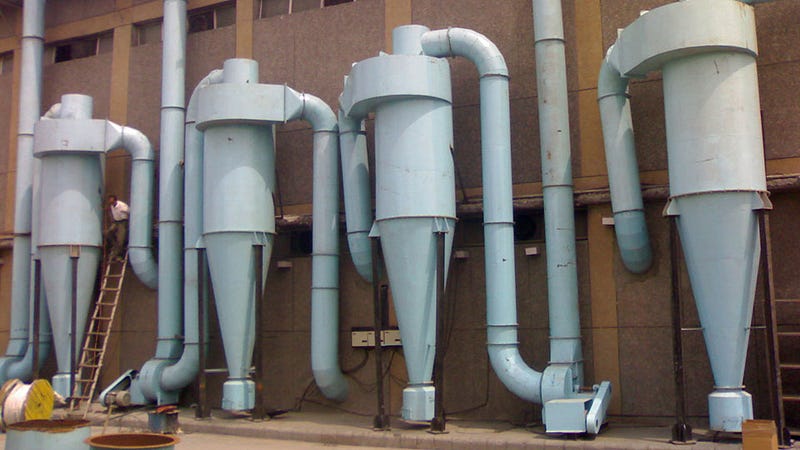
Managing this dust is not only about keeping the workplace clean. A well-planned extraction system can make routine housekeeping easier and help industries maintain a more organized production environment. It also allows dust to be collected closer to the point where it is generated instead of letting it travel throughout the facility.
Cyclone dust collectors are commonly used for separating heavier particles from an air stream. Their operation is based on centrifugal force, which pushes larger and heavier particles away from the moving air. Because of their relatively simple working principle, they can be used in many industrial applications.
Shimi Research provides customized dust collection solutions for different industries. As a Cyclone Dust Collector Manufacturer in Delhi, the company focuses on understanding the application before suggesting an equipment configuration. Airflow, particle size, dust concentration, temperature, installation space, and other operating conditions can all influence the final design.
What Is a Cyclone Dust Collector?
A cyclone dust collector is a mechanical device designed to separate solid particles from moving air or gas. Unlike systems that depend mainly on filter media, cyclone technology uses centrifugal force to separate heavier particles.
When contaminated air enters the cyclone chamber, it begins to rotate. As the air moves in a circular pattern, the heavier particles are pushed toward the outer wall. These particles then lose their speed and move downward into a collection hopper.
At the same time, the cleaner air changes direction and moves toward the outlet.
The principle is straightforward, which is one reason this type of equipment is used in many industrial applications. It can handle a considerable amount of coarse material and can also be used as the first stage in a multi-stage filtration system.
For applications that contain both coarse and fine particles, a cyclone can remove the heavier material first. A secondary filtration unit can then handle the finer particles that remain in the air stream.
How Does the Separation Process Work?
Understanding the working process makes it easier to see why cyclone technology is useful.
The process generally follows these stages:
1. Dust enters with the air
Dust-filled air is collected from the production area and transported through ducting toward the cyclone.
2. Air starts rotating
The inlet arrangement causes the air to move in a circular path inside the chamber.
3. Centrifugal force separates particles
As the air rotates, heavier particles move toward the outer wall because of centrifugal force.
4. Dust moves downward
After contacting the wall, the particles lose velocity and fall toward the lower section of the unit.
5. Dust is collected
The separated material gathers in the hopper or collection section.
6. Cleaner air exits
The air with a lower concentration of heavier particles moves toward the outlet.
The actual separation efficiency depends on several factors, including particle characteristics, airflow, cyclone dimensions, inlet conditions, and system design. Therefore, proper sizing is important.
Why Do Industries Need Proper Dust Collection?
Dust can spread surprisingly quickly in a busy industrial environment. A process may generate particles at one machine, but without local extraction, those particles can move to other areas through natural air movement, fans, or employee activity.
Once dust spreads throughout the facility, cleaning becomes more difficult. Machines may need more frequent cleaning, and production areas can become harder to maintain.
A source-capture approach is generally more practical. Instead of waiting for dust to spread, extraction equipment collects it near the point of generation.
A properly designed system can help with:
- Better control of airborne particulate matter
- Easier housekeeping
- Reduced dust accumulation around machinery
- More organized production areas
- Controlled movement of dust through the facility
- Integration with additional filtration equipment
The actual benefits depend on the application and the quality of the overall system design.
This is why industries should not select equipment only by looking at capacity or physical size. The entire extraction arrangement needs to be considered.
What Factors Affect Dust Collector Selection?
Every industrial process produces a different type of dust. Some particles are large and heavy, while others are very fine. Some processes operate at normal temperatures, while others produce hot gases.
Several factors should therefore be evaluated before selecting equipment.
Airflow
Airflow determines how much contaminated air the system needs to move. The collector and blower should be matched to the required volume.
If the airflow is insufficient, dust may remain at the pickup point. On the other hand, excessive airflow can increase energy requirements without necessarily improving the result.
Particle Size
Particle size has a direct impact on separation. Cyclone technology generally performs better with larger and heavier particles. Fine particles may require an additional filtration stage.
Dust Concentration
The amount of particulate matter entering the system should also be considered. High-dust applications may require suitable hopper capacity and an appropriate discharge arrangement.
Material Characteristics
The properties of the dust can influence equipment selection. Some materials may be abrasive, sticky, combustible, or sensitive to temperature. These characteristics should be discussed during system planning.
Temperature
If the process produces hot air or high-temperature particles, the construction material and components should be selected accordingly.
Pressure Drop
Pressure drop affects the blower and the performance of the complete system. The collector, ductwork, filters, and fan should therefore be evaluated together.
Space
The available installation area can influence the shape, height, and arrangement of the equipment. A customized layout may be necessary where floor space is limited.
What Are the Advantages of Cyclone Technology?
Cyclone systems are popular because they offer a relatively straightforward approach to separating heavier particles.
Some practical advantages include:
- Simple operating principle
- Suitable for coarse and heavy dust
- Can handle high dust loading in appropriate applications
- No filter media is required for the primary separation stage
- Can operate continuously in suitable industrial conditions
- Can reduce the load on secondary filtration equipment
- Can be integrated into centralized extraction systems
- Can be customized for different layouts
Another advantage is that the cyclone can act as a pre-separator. When used before a cartridge filter or another fine filtration unit, it can remove larger particles before they reach the filter.
This can make the overall filtration arrangement more practical for processes where particle sizes vary significantly.
Where Are These Systems Commonly Used?
The suitability of cyclone equipment depends on the dust characteristics and process conditions, but the technology is used across many industries.
Woodworking and Furniture
Cutting, sanding, routing, and other woodworking processes can produce chips and dust. A suitable extraction system can collect these particles from individual machines.
Metal Processing
Grinding, polishing, and other operations can produce metal particles. Proper extraction can help capture these particles before they spread around the work area.
Foundries
Foundry operations can involve dust during material handling, casting, cleaning, and finishing. Separation equipment can form part of the wider extraction system.
Mineral Processing
Crushing, screening, and material transfer can produce substantial quantities of particulate matter. A primary separator can be useful where heavier material is present.
Chemical and Powder Processing
Industrial processes involving powders may require controlled handling of airborne particles. The appropriate equipment depends on the physical properties of the material.
General Manufacturing
Manufacturing plants may generate dust during grinding, mixing, cutting, crushing, and material handling. A centralized system can connect several extraction points to one collection arrangement.
Can Cyclone and Cartridge Filtration Be Used Together?
Yes. In many applications, using more than one separation stage can make sense.
The cyclone can handle the larger and heavier particles first. The air then passes to a cartridge filter, which captures finer dust.
For example:
Production Machine → Extraction Hood → Ducting → Cyclone → Cartridge Filter → Blower → Outlet
The actual sequence can vary depending on the application.
The main idea is to give each stage a specific job. The first stage removes heavier material, while the secondary stage deals with finer particles.
This arrangement may:
- Reduce the dust load reaching the final filter
- Improve the overall filtration process
- Help manage mixed particle sizes
- Make maintenance more manageable
- Provide multiple stages of particle separation
Shimi Research also offers Cartridge Filter Dust Collector systems for applications that require fine-particle filtration.
However, a combined system is not automatically necessary. The right solution should be determined by testing or evaluating the actual process conditions.
What Is a Dust Extraction System?
A dust extraction system is a complete arrangement used to capture, transport, separate, filter, and collect dust generated during industrial operations.
The dust collector is only one part of this system.
A typical setup may include:
- Extraction hoods
- Pickup points
- Ducting
- Dampers
- Cyclone separator
- Cartridge or other filter
- Blower or fan
- Hopper
- Dust discharge equipment
The extraction hood captures dust from the machine. Ducting transports the contaminated air toward the collection equipment. The separator and filters remove the particulate matter, while the blower maintains the required air movement.
If any one component is poorly selected, the overall performance can suffer. For example, an undersized duct may create excessive pressure loss, while an incorrectly selected blower may fail to provide the required airflow.
This is why system design is just as important as the collector itself.
Why Is Proper Ducting Important?
Ducting is often overlooked when people discuss dust collection, but it plays a major role in system performance.
The ducts must carry contaminated air from the pickup points to the collection equipment without creating unnecessary pressure losses.
Important considerations include:
- Duct diameter
- Total duct length
- Number of bends
- Branch connections
- Air velocity
- Pressure loss
- Layout of the production area
A poorly designed duct network can reduce extraction performance even when the main collector is correctly sized.
For facilities with multiple machines, the ducting layout should be planned carefully so that the required airflow reaches each pickup point.
How Can Shimi Research Help With Dust Collection?
Selecting an industrial dust collection solution can be difficult when the process has multiple dust-generating points or unusual operating conditions. A manufacturer with application knowledge can help determine which components are appropriate.
Shimi Research provides customized solutions for different industrial requirements. The company considers factors such as airflow, dust characteristics, particle size, temperature, and installation space while planning equipment.
As a Cyclone Dust Collector Manufacturer in Delhi, Shimi Research focuses on solutions for applications where heavier particulate matter needs to be separated from industrial air streams.
The company also provides cartridge-based filtration equipment for finer dust applications.
Shimi Research has another product, Cartridge Filter Dust Collector, which can be considered when the process requires finer filtration. Depending on the application, a primary separator and secondary filter can be integrated into one complete system.
 Deutsch
 English
 Arabic
 French
 Spanish
 Portuguese
 Turkish
 Dutch
Dutch
 Italiano
 Russian
 Romaian
 Portuguese (Brazil)
 Greek
Greek