

Professional Company Registration in Mexico
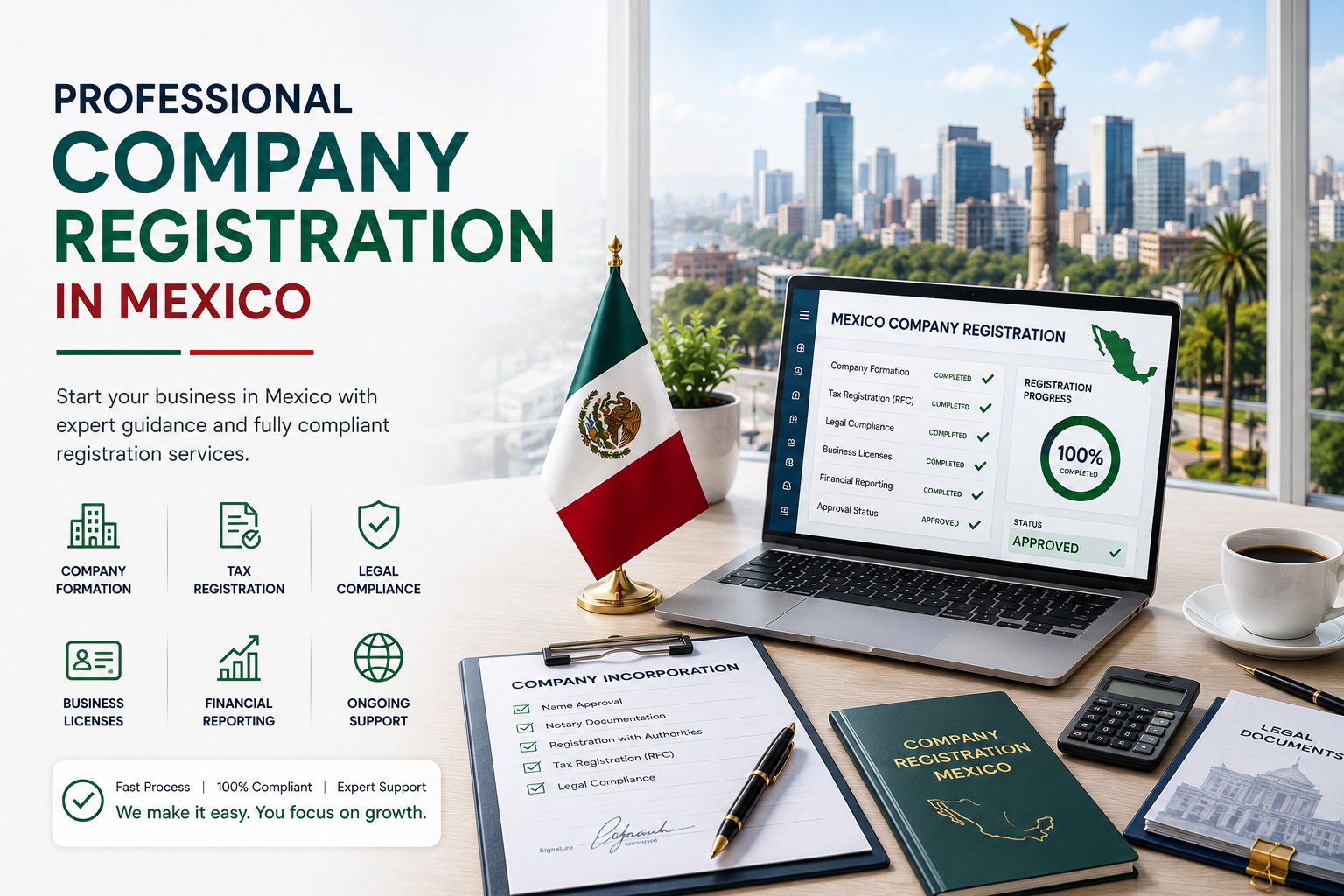
Mexico has become one of the most talked-about destinations for foreign business right now, largely thanks to nearshoring and its close trade ties with the US and Canada. But there's a gap between how simple registering a company there sounds and how it actually plays out. On paper, the steps are short and clear. In practice, the process is full of sequential dependencies one delay early on pushes everything after it back by the same amount which is exactly why so many foreign founders bring in professional help rather than trying to navigate it solo.
Choosing the Right Entity From the Start
Before any paperwork gets filed, you have to decide what kind of company you're actually forming. The S.A. de C.V. remains the default choice for most foreign investors it requires just one peso of minimum capital, imposes no nationality restrictions on shareholders or directors, and is flexible enough to suit almost any size of operation. For startups planning to raise venture capital or bring in institutional investors, the SAPI is often the better fit, since it allows special share classes and more customizable governance than the standard corporate law provides. There's also the S.A.S., a simplified structure aimed at solo founders and small tech ventures, though it comes with a revenue cap that limits how far it can scale. Getting this choice right at the outset matters, because restructuring later tends to be more expensive than doing the analysis properly the first time.
Where the Process Actually Slows Down
The individual legal steps of Mexican incorporation aren't complicated in isolation: authorize a company name with the Ministry of Economy, draft and notarize the incorporation deed (the Acta Constitutiva), file it with the Public Registry of Commerce, then register for a tax ID with the SAT. The trouble is that each of these steps depends on the one before it, and a couple of them are notorious bottlenecks. Getting the RFC, company registration in Mexico federal tax ID, requires an in-person appointment, and the legal representative typically has to attend twice once for the tax ID itself and again for the digital signature needed to actually operate. Appointment slots can be booked out for weeks. Opening a corporate bank account tends to be the single longest stretch of the whole process, often taking a month or two on its own, mostly due to know-your-customer requirements that Mexican banks apply rigorously to foreign-owned entities.
Put together, most realistic estimates put the full process from first document to a working bank account somewhere between eight and twelve weeks for straightforward cases, with well-prepared, simple structures sometimes finishing in as little as a month, and more complex or foreign-heavy ownership situations stretching to several months.
The Compliance Layer Nobody Should Skip
Getting incorporated is not the same as being fully operational, and this is where professional guidance earns its fee. Companies with any foreign ownership must register with the National Registry of Foreign Investment within 40 business days of a specific trigger date, and missing that window results in fines. Mexico's electronic invoicing system, CFDI, is mandatory for virtually all business activity, and a 2026 reform to the country's tax code introduced stricter "proof of reality" requirements for comply globally these invoices, with real financial penalties for non-compliance. None of this is optional bureaucracy you can quietly ignore invoices without a valid RFC simply aren't deductible, and companies operating outside these rules can find their bank accounts frozen or face penalties that scale with the size of the violation.
Why "Professional" Actually Means Something Here
Mexico isn't a jurisdiction where downloading a template and muddling through tends to work out. The interplay between notaries, the tax authority, foreign investment registration, and increasingly strict transparency rules around beneficial ownership means small missteps compound quickly. A professional registration service typically handles the sequencing, keeps appointments and deadlines from slipping, and ensures the entity structure matches both your immediate operating needs and your longer-term plans including how you intend to invoice, hire, and eventually repatriate profits. Done properly, the process becomes genuinely manageable. Done without guidance, it's the kind of thing that can quietly cost a founder months.
 Spanish
 English
 Arabic
 French
 Portuguese
 Deutsch
 Turkish
 Dutch
Dutch
 Italiano
 Russian
 Romaian
 Portuguese (Brazil)
 Greek
Greek